New Room Matching Runs in the Shadow First
Before replacing a room list people read every day, let the new answer write quietly beside it for a week.
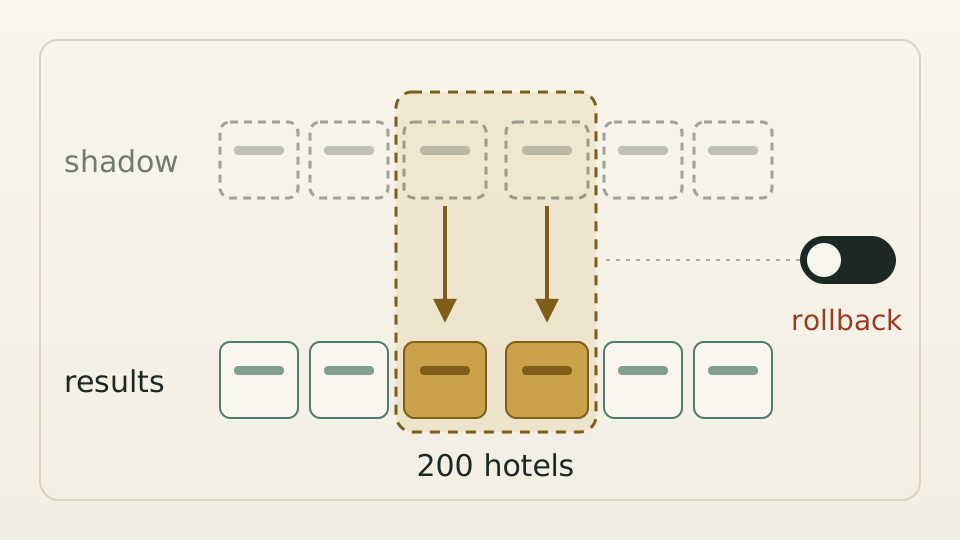
The new room-type matching only observes today; it does not rewrite search results. We designed a pilot for switching it on: the 200 best-selling hotels in one city, a few named customer accounts, one week of watching, and a rollback that is just clearing a list. It is a plan, not a live feature.
The same room can be a Standard Double at one supplier, a Superior King at another and a string of abbreviations at a third. Room-type matching groups those names into one room type, so a guest sees one line in the results instead of five lines that look different but are the same room. The new matching algorithm runs in shadow for now: it works through a sample of searches in the background and records its answer without changing what guests see.
Moving from recording to rewriting is not mainly an algorithm problem. Inside the system, the room-type ID is a key: stop-sell rules, room types a customer has blocked, buyers’ pricing rules and rebooking matches all look rooms up by it. Switch rewriting on everywhere and you change every door that key opens, not one line on a page. So this step starts with a design, not with code.
The pilot it describes is narrow: the 200 hotels with the most bookings in one city, for a few named customer accounts. The hotel list lives in distribution settings those accounts already have, with no new storage, and rolling back means clearing the list or switching it off, with no release. During a week of watching, three things trigger a rollback: different room types merged together, worse latency or errors, and billing anomalies. The match rate only decides whether to widen, because an unmatched room is never rewritten.
To pass, the pilot needs at least seven full days, counted from the last hotel added to the list, without any rollback trigger firing, followed by a named sign-off from the person responsible. A smooth pilot does not lower the bar beyond it: widening to more hotels or customers still requires the full gate of 30 days of data and 50,000 human-labelled samples. What is described here is a plan and its reasoning, not a live feature.