One Reason Code Can Change a Night of Availability
Sometimes availability does not drop. The meaning of “cannot sell” changes.
A room can be simultaneously sellable in one channel and paused in another. It is often not missing inventory, but split object boundaries. A reason code, time window, and scope written as one object keeps sales actions from colliding.
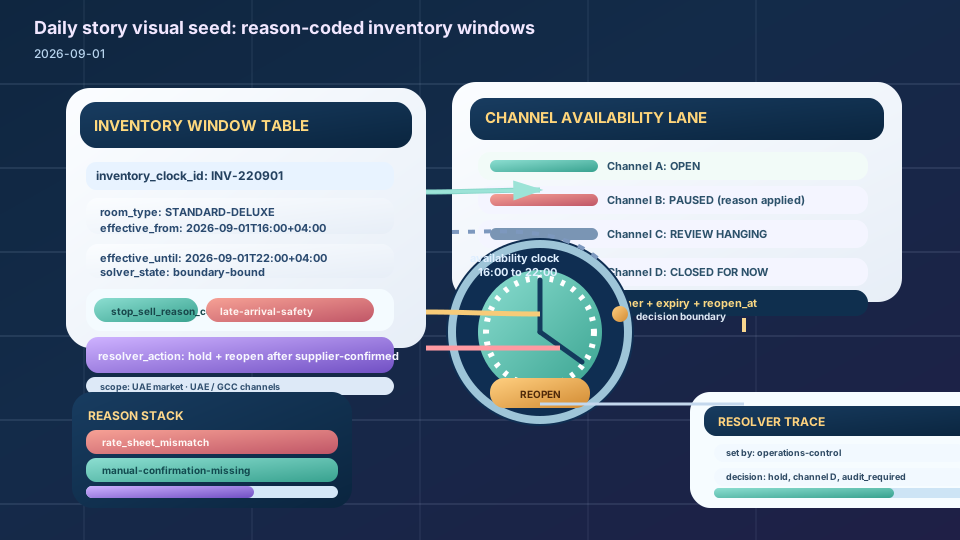
A hold is not always caused by “no rooms left.” Sometimes it is caused by a state that was never precise: one channel writes an empty stop-sell reason when supplier sync is partial, another channel shifts the close time because a timezone offset is interpreted differently. The same room for the same date can appear both available and blocked at once, even though no one actually changed the room count.
We tend to ask “why is inventory lower?” but a better question is “which layer decided it is not for sale?” If `stop_sell_reason` and `inventory_window` are maintained by different owners, on different rhythms, from different versions, one logical room-type becomes two competing facts. In high-pressure windows like last-minute releases, that split is more than technical debt; it is an operating delay loop.
The practical tradeoff is not “open first, fix later.” It is choosing bounded waiting over blind throughput. A conservative stop-sell is acceptable only if the object includes who set the pause, which reason code applies, when release is allowed, and which channels are actually affected. Then finance has a consistent risk boundary, operations has a deterministic restart time, and support has one sentence instead of three.
In HotelByte, an inventory object is not a row with a count. It is a commitment: who can sell what, where, and until when. Bringing `stop_sell_reason`, `effective_from`, `effective_until`, `channel_scope`, and `resolver_action` into one reviewable card ends the “empty field = unknown state” pattern. One less guess. One less duplicate follow-up.