The Same Shuttle, Different Outcome, Same Coordinates
A meeting_point field in the content pack is not a caption; it decides routing, pickup scope, and a sellable promise.
Content packs often carry both a note and a coordinate pair for meeting_point. If the two differ by only a few decimals, the assigned pickup point can shift by a floor and the distribution promise becomes inconsistent. Making coordinate, precision policy, semantic version, and expiry a single distribution object creates a sustainable audit path.
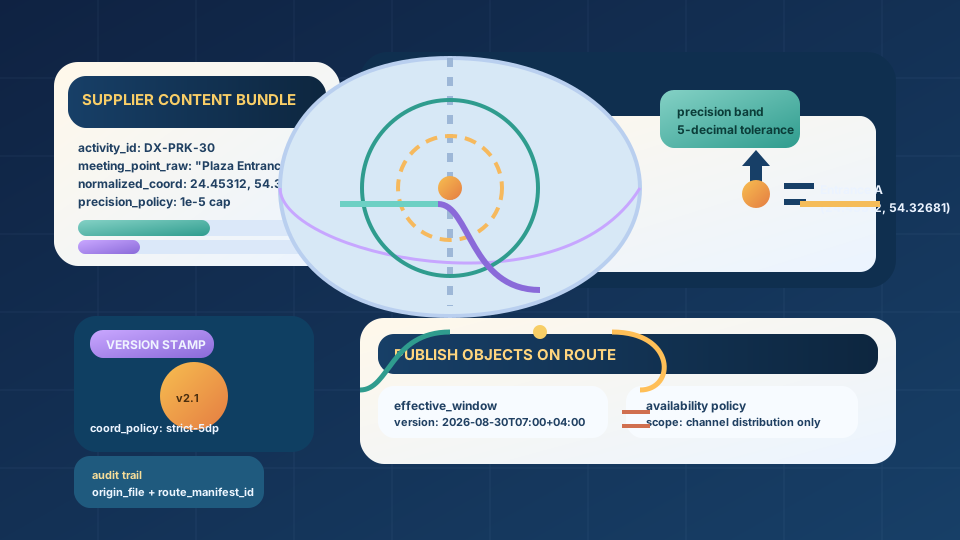
A recent content refresh changed the note from “Downtown Plaza Entrance A” to “Plaza Entrance.” It sounded minor, but the real shift was in coordinates: one file had 24.45312, 54.32681, another truncated to two decimals. For a person, that can look like a harmless typo; for channel routing, it can be a different pickup gate.
More importantly, distribution pipelines often consume coordinates first and human text second. If precision policy differs, the same event can be resolved into two sellable objects: one marked pickup-allowed, one marked pickup-restricted. That ends up looking like operations drift, while the root cause is a content object with no stable boundary.
The tradeoff is practical. Requiring full precision from every supplier is stable but heavy to adopt; forcing a fixed three-decimal policy is easy to implement but can erase useful local detail. Relying on free-text matching is fragile once “Entrance A” and “Entrance A (west wing)” enter the same pipeline. A practical boundary keeps raw_meeting_point, normalized_meeting_point, precision_policy, source_ref, and effective_window together on one row.
This story is not a generic platform sermon. It is the reminder that a lot of distribution risk starts as one ambiguous field. When coordinates and versioning become reviewable, “wrong gate” cases stop being mysteries. The team can trace which file version, precision rule, and channel route changed the same event, and fix the chain instead of blaming one team in isolation.