Search in Chinese, Find Hotels Listed Only in English
The list says Hengyang. Someone types 衡阳. Between the two sits one translation.
Hotel lists imported from a spreadsheet often carry English names only, so a Chinese place name finds nothing. Now, when a direct search comes back empty and the keyword contains Chinese characters, the system asks the platform’s multilingual place index for the English name and searches your list again.
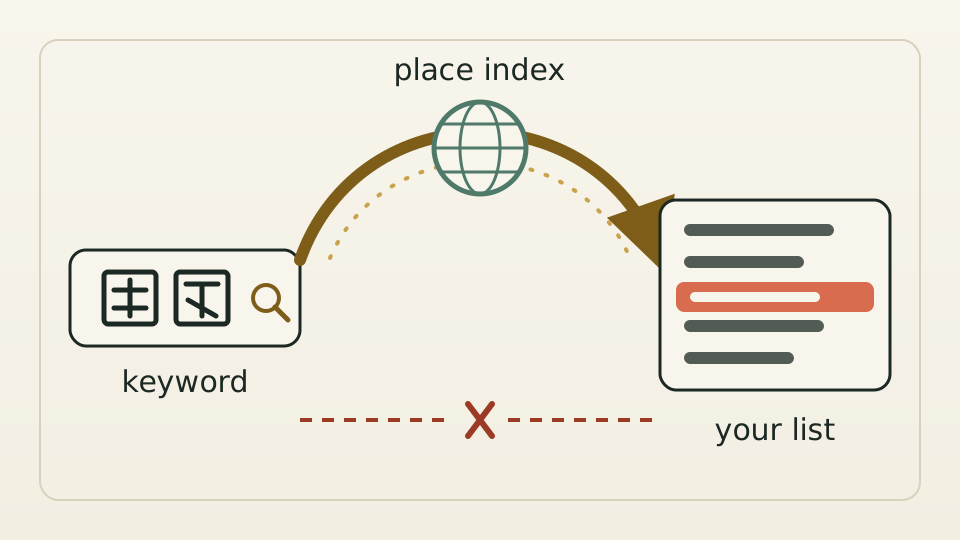
Many sellers build their own hotel list from an English spreadsheet: English hotel names, English city names. Once imported, the list is searchable and sellable, until a colleague who works in Chinese types 衡阳 into the suggestion box and gets nothing. The list does have hotels there. It just never contains those two characters, only the word Hengyang.
The obvious fix is to add Chinese names to the whole list. That means reworking someone else’s data, and doing it again after every re-import. The other easy path is fuzzy matching on the Chinese keyword, but a two-character place name is too short to match reliably, and loosening the match drags in unrelated results.
Hotel suggestions now borrow the platform’s multilingual place index. Only when the direct search returns nothing and the keyword contains Chinese characters does the system send it to the index, take up to three English place names that the index counts as a match, and search your list again with them. The lookup waits at most 500 milliseconds. Searches that already hit directly never take this detour, and your list itself is left untouched.
The bridge understands places, not hotel names. Typing a Chinese city finds hotels whose entries carry the English city name; typing a hotel’s Chinese name still finds nothing if the list only holds its English name, until the list itself gains Chinese names. And when the place index fails, that step is treated as an error rather than quietly reported as no results.