Showing the Chinese Name Beside the English One
A long English name is a fine label until a Chinese reader has to guess which hotel it is.
Storefront search results were changed so that, in the Chinese interface, a hotel whose Chinese name is in the content library reads “English name (Chinese name)”. A missing or identical Chinese name leaves the English name alone, never empty brackets.
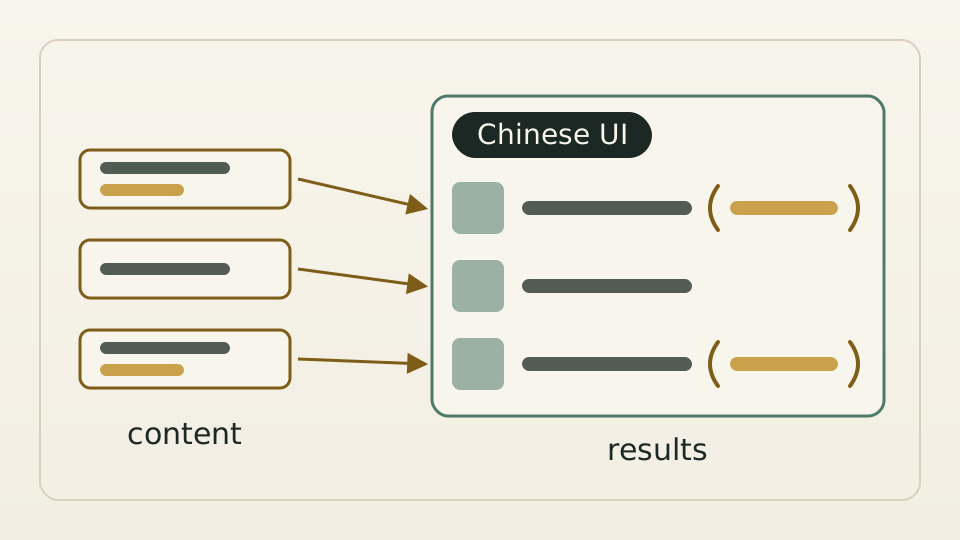
Guests using the storefront in Chinese used to see search results made entirely of English hotel names. That is fine for readers at home in English, but for many Chinese readers a long English name is hard to recognise at a glance, so they open hotel after hotel and check photos and addresses before they are sure which one it is.
Some hotels in the content library carry a Chinese name; many do not. One possible rule would show Chinese names only when someone searches a Chinese city. That ties the rule to a country, while what really decides whether a Chinese name can be shown is whether the hotel has one. So the rule checks just two things: is the interface in Chinese, and does this hotel have a Chinese name.
When both hold, the result row reads “English name (Chinese name)”, English first with the Chinese name added in brackets. If the Chinese name is missing, or identical to the English one, only the English name appears: no empty brackets and no name written twice. Even the fallback for a hotel with no name follows the interface language. The change is limited to storefront search results; the portal’s B2B search is unchanged and no field was added to the API.
Because the rule depends only on the data, a hotel in any country shows its Chinese name as soon as the content library holds one, and adding Chinese names for more hotels later needs no change to the code. For now few hotels in the content library have a Chinese name, so until more are filled in, most results will still show only the English name.